Saving The Earth...One Jersey Tomato At A Time
Okay, so the headline is a bit of hyperbole. But the intent is there. Planting a Victory Garden, and I'll get to who the victory is over in a bit, is something I've been thinking of doing for a couple of years. We have the land to put in a good garden, about an acre and a half, if not the exactly the time (we have four kids).
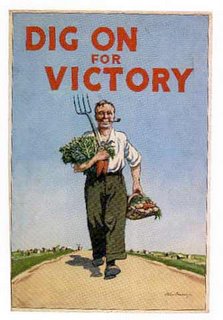
So why call it a Victory Garden? Call this my merging of several interests and concerns. I've always liked garden vegetables over store bought ones, they just have more flavor and seem to be bigger than what you can get in the produce department of X-supermarket chain. I am also highly concerned about global warming, big oil and our involvement in the Middle East. So, how does all this get wrapped up in a compost pit and some planters in my back yard?
The average food item in your grocery store travels nearly 1,500 miles to get there. Here's a good example, most broccoli in America is raised within 20 miles of the average American house. But broccoli purchased in a store travels, on average, 1,800 miles to reach the shelves. That's a big carbon footprint your leaving when you buy supermarket produce.
It takes a lot of fossil fuels to get that broccoli from the farm to your table. From the tractors and farm equipment used to grow it, to the planes, trains, ships and trucks used to transport it, to the refrigeration system in the warehouse sized building where it is sold. The burning of fossil fuels releases carbon dioxide, sulfur dioxide, particulate matter and other pollutants into the atmosphere. The overabundance of these in our atmosphere contribute to global warming, smog, air pollution and acid rain. These in turn are harmful to the planet and harmful to you.
Additionally, a lot of plastic and styrofoam is used in the packaging and presentation of grocery store food items, to make it appealing to you and to keep it fresh (or at least give the impression it is fresh). Not to include the plastic bags your purchased items are placed in. Plastic and styrofoam take a long period of time, to break down and recycle, though at least they do, unlike glass and aluminium.
Think globally, act locally and what is more local than your backyard? Whatever you can grow on your own will reduce your own personal carbon footprint. Is it going to stop the big agribusiness corporations from growing produce in one corner of the globe and shipping it to another. Individually, no, but collectively perhaps.
So the connection to big oil then, I think, is kind of obvious. Call me cynical but I don't think the big oil companies (or any oil companies for that matter) have a huge concern for the environment, other than having good PR. But who needs to be environmentally concerned when your the supplier of the petro-based industrial world?
But it's more than just contributing to global warming that makes big oil repugnant to me, it is the fact that, when the American middle class is being squeezed to death the oil industry, at the same time, reaped huge tax breaks from the government. And I mean huge, $5 billion dollars worth. This, when oil companies such as Exxon-Mobil are reporting $36.13 billion in profits for 2005, the all time revenue high for any company, ever. (They are reporting $10.7B for the third quarter of 2006)
They are a main contributor to global warming, their lobbyist block efforts by the government to tax their profits (I wish someone would lobby the government on my behalf so they won't tax my profits) and they are fighting against the introduction of alternative energy to protect their share of the energy market.
Okay, so now the big finale. You probably already saw it coming. So it takes a lot of fossil fuels to move produce to market, fossil fuels put pollutants in the air, pollutants are bad for us, oil companies are the producers of fossil fuels, make enormous profits off of us and do not have to pay taxes on those profits and at the same time block efforts to produce more environmentally friendly energy sources, but what about where those fossil fuels come from?
Well we produce approximately 42% of our own oil needs (about 7.3 million barrels a day) and we import the rest. The majority of that oil, 88% is imported from countries NOT in the Middle East, like Canada, Venezuela, Mexico, Nigeria, Algeria, Ecuador, and England. We only get 12% of our oil from Saudi Arabia, Iraq, Kuwait, etc. Despite this we are deeply imbedded in the Middle East vis-a-vis geopolitics. I realize this is a murky mix of oil needs, alliances, support of Israel and so on but think of it in these terms: If we could conserve just 12% of 58% percent of our oil needs we would really, other than support of Israel, have little need to be involved geopolitically in the Middle East.
Let's make that clearer, if we use 7.3mbd that equates to 2.66 billion barrels a year. Fifty-eight percent of that is imported, or 1.54bby. Of that amount, 20% comes from the Middle East or 308 million barrels a year. In terms of our total use that's about 11% of our oil needs. If America could conserve just 11% of our oil consumption we would have no need, geopolitically speaking, to be in the Middle East. Without a need to be there there is no Iraq war, there is a smaller US presence thus reducing a large impetus for Islamic terrorism against US citizens and interest, there is less of a clash of secularism with Islam.
So that is who the Victory is over, global warming, big oil and getting America out of a region it has no business in anyway.
My goal is to raise 10,000 pounds of fruit and veggies from my garden. It's realistically doable Maybe not in the first year but eventually. Perhaps it is a Quixotian type quest but as Teddy Roosevelt said, "if he fails, at least fails while daring greatly, so that his place shall never be with those cold and timid souls who know neither victory nor defeat". (Full Quote
In World War II the government encouraged the nation to plant Victory Gardens to help with the war effort. Twenty million were planted. They produced enough food that 70% of the vegetables on the home front and 30% of those consumed by the troops were from Victory Gardens. How great would it be if the US Government would get behind those efforts today?
Okay, that was a lot longer than I intended. Next update will be shorter and present the garden plan!
posted by RIRedinPA @ 11/22/2006 06:14:00 AM


0 Comments:
Post a Comment
<< Home